Here’s what we’ve learned: the right air purifying plants do more than just filter the air — they actively improve your whole indoor environment. These air purifying plants release moisture steadily, helping counter low-humidity conditions that can make your HVAC system work harder and leave your family feeling the effects in their skin, sinuses, and sleep. The key is choosing air purifying plants that deliver benefits while still being safe around curious pets.
This page gives you exactly that — a vetted, specific list built around all three criteria at once, so you can add greenery to your home with confidence.
TL;DR Quick Answers
air purifying plants
Air purifying plants absorb indoor VOCs — including formaldehyde, benzene, and trichloroethylene — through their leaves and root systems via a process called phytoremediation. The top pet-safe options confirmed by NASA research and verified against the ASPCA toxic plant database are:
Spider plant — removes formaldehyde and carbon monoxide; safe for dogs and cats
Areca palm — releases up to a liter of moisture daily; filters benzene and trichloroethylene
Boston fern — strongest humidity output of common houseplants; removes formaldehyde
Bamboo palm — effective in low light; filters formaldehyde and benzene; pet safe
Parlor palm — low maintenance; moderate air purification; safe for dogs and cats
Calathea — high transpiration rate; strong humidity contribution; pet safe
Key facts:
Place one to two medium plants per 100 square feet for measurable VOC reduction.
Plants supplement HVAC filtration — they do not replace it.
Always verify pet safety against the ASPCA toxic and non-toxic plant database before purchase.
Top Takeaways
Pet safety comes first. Peace lily, pothos, and philodendron are toxic to dogs and cats — yet appear on most air-purifying plant lists. Every plant here is verified against the ASPCA's full toxic and non-toxic database before making the cut.
The best plants clear three bars at once. Spider plants, Boston ferns, areca palms, and calatheas filter VOCs, release moisture to offset low humidity, and are safe for pets — criteria most plant guides evaluate separately, if at all.
Plants and filters solve different problems. Plants absorb gases and support humidity passively. HVAC filters capture fine particulates, pet dander, and allergens plants cannot reach. One without the other leaves gaps.
Placement determines impact. One plant in a corner changes nothing. Concentrate plants where time-in-space is highest — bedrooms, living rooms, and home offices. Start with one medium-to-large plant per 100 square feet.
Indoor air is more polluted than most families know. The EPA documents indoor VOC concentrations up to ten times higher than outdoors. The households we've helped most treat indoor air quality as an ongoing system — not a one-time fix.
Why Most Air-Purifying Plant Lists Miss the Mark for Pet Owners
The problem with most air-purifying plant guides is that they were written for a home without animals. Popular choices like pothos, peace lily, and philodendron appear on nearly every list — and every one of them is toxic to dogs and cats. In our experience helping over two million households breathe better, we've seen pet owners make this mistake and not realize it until a vet visit.
Choosing a plant for your home means evaluating three things at once: air-cleaning ability, humidity contribution, and pet safety. Most guides only address one.
How Plants Actually Improve Indoor Air and Humidity
Plants improve indoor air through two mechanisms that are often conflated but work differently.
The first is phytoremediation — the process by which plants absorb airborne compounds like volatile organic compounds (VOCs), formaldehyde, and benzene through their leaves and root systems. NASA's Clean Air Study brought this concept into the mainstream, and while a single plant won't transform a room, a strategic grouping of the right species can make a measurable difference alongside proper filtration.
The second is transpiration. As plants draw water from their roots and release it through their leaves, they add moisture vapor to the surrounding air. In low-humidity environments — common in winter months when heating systems run continuously and strip moisture from the air — this process provides passive, chemical-free humidity support that can reduce the strain on your HVAC system and ease dryness symptoms for your family.
The plants that do both well, safely, are the ones worth knowing about.
The Best Pet-Safe Plants for Air Purification and Low Humidity
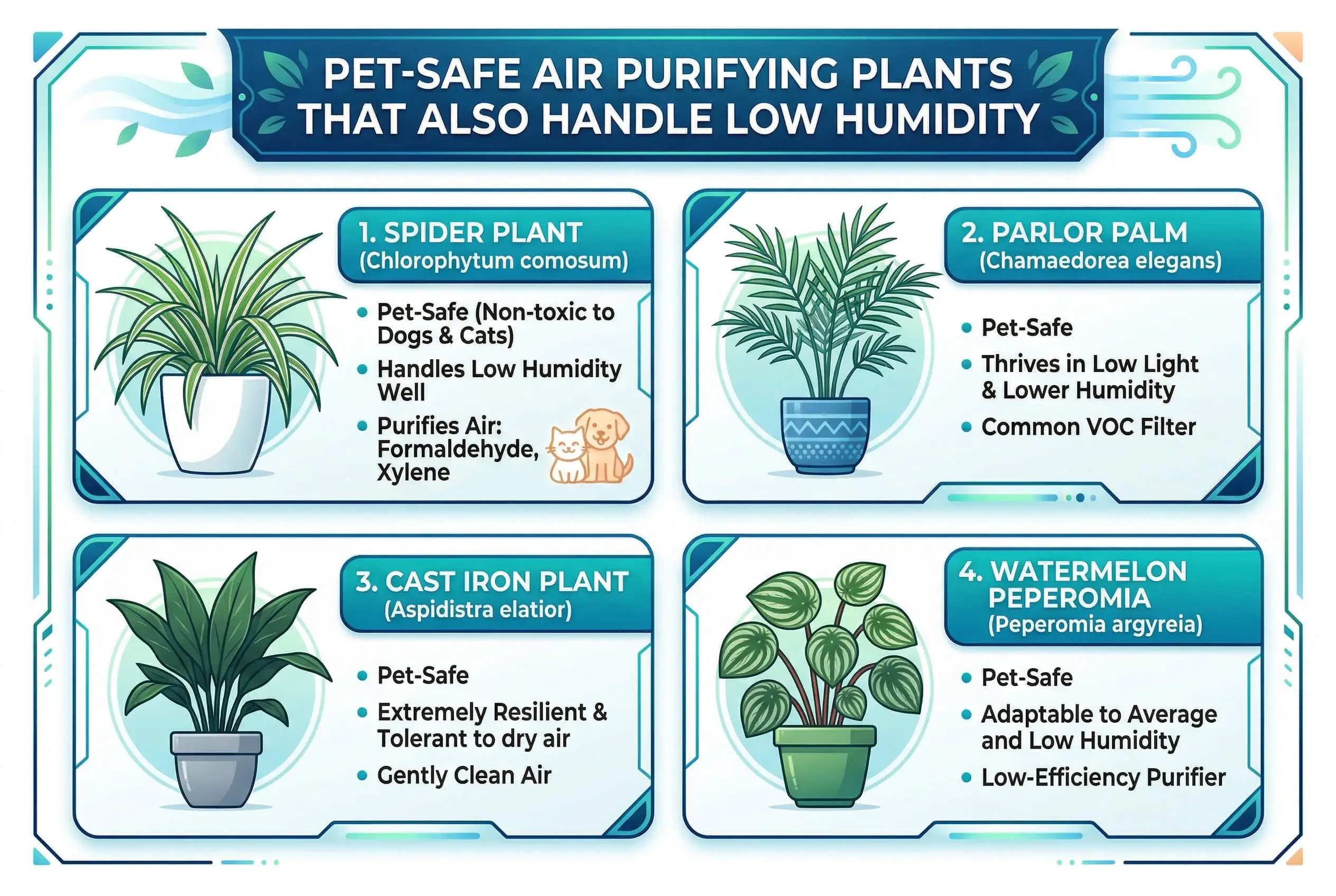
The following species are confirmed non-toxic to dogs and cats according to the ASPCA, and each brings meaningful air-cleaning or humidity-boosting properties to your home environment.
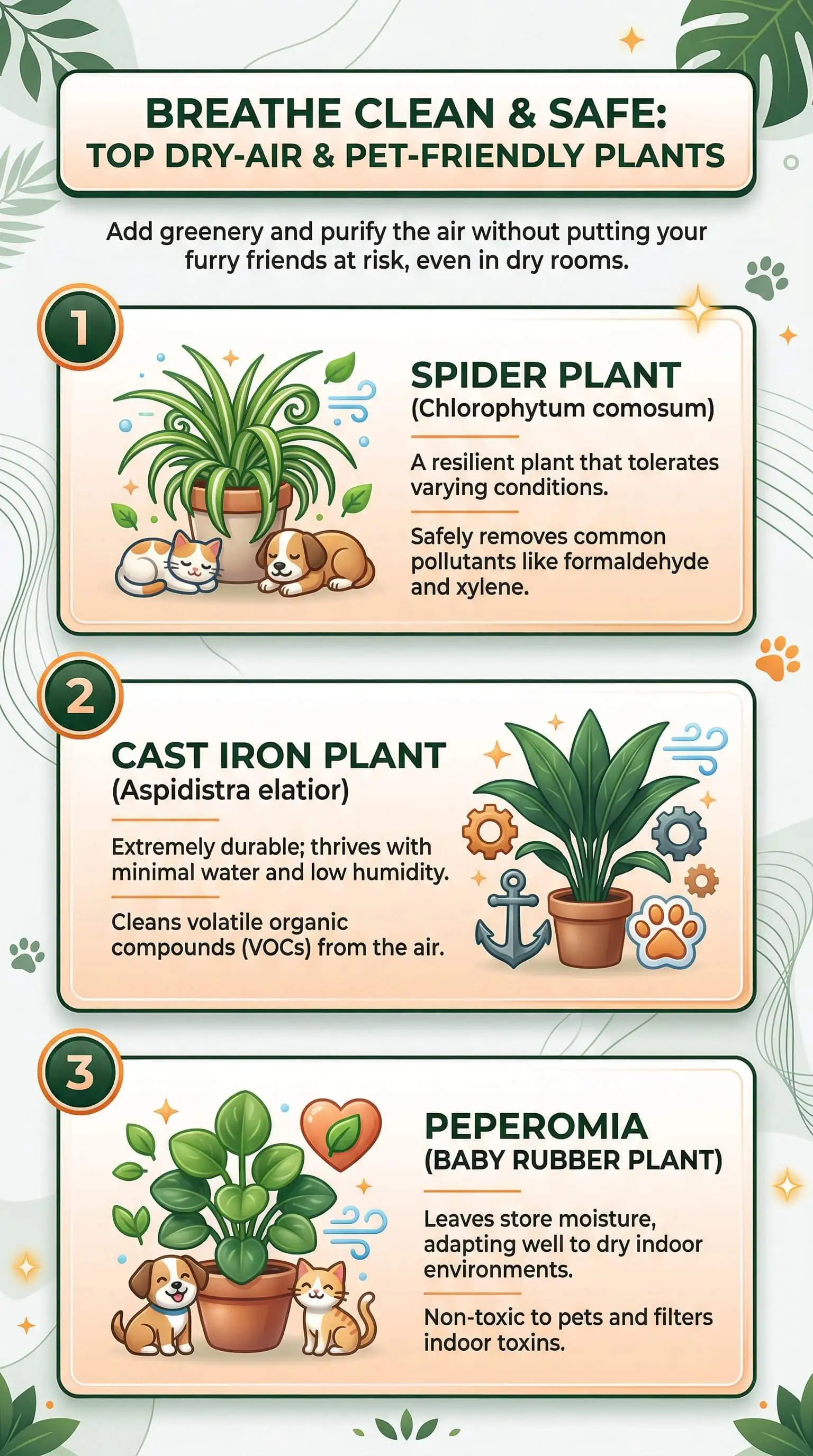
Spider Plant (Chlorophytum comosum) — One of the most effective VOC absorbers identified in controlled studies, the spider plant is also a strong transpirer, releasing consistent moisture into dry air. It's nearly indestructible, tolerates low light, and is fully safe for pets. For households managing winter dryness, a cluster of three or more in a main living area delivers the most impact.
Boston Fern (Nephrolepis exaltata) — Among the highest-rated plants for moisture release, Boston ferns are natural humidifiers. They also remove formaldehyde and xylene from the air — compounds commonly off-gassed by furniture, flooring, and cleaning products. They require consistent watering and indirect light, but the payoff for dry-air households is significant.
Areca Palm (Dypsis lutescens) — Often called a living humidifier, the areca palm releases close to a liter of water per day through transpiration when well-watered. It also filters benzene and trichloroethylene. It's a larger plant suited to bright rooms, and it's one of the most pet-safe palms available.
Bamboo Palm (Chamaedorea seifrizii) — A compact, low-light alternative to the areca palm, the bamboo palm is confirmed safe for pets and ranked highly in NASA's clean air research for removing formaldehyde and benzene. It also contributes steady moisture to dry environments.
Calathea (Calathea spp.) — Calatheas are prolific transpirors due to their large leaf surface area, making them particularly useful for boosting humidity. They filter airborne toxins and are non-toxic to pets. They prefer indirect light and consistent moisture, making them well-suited for bathrooms and bedrooms where humidity needs are highest.
Parlor Palm (Chamaedorea elegans) — Tolerant of low light and minimal watering, the parlor palm is one of the easiest large plants to maintain. It contributes air purification and moderate humidity, and it's safe for both dogs and cats.
Where to Place Plants for Maximum Air and Humidity Impact
Placement matters more than most homeowners realize. A single plant in a corner will not meaningfully improve air quality or humidity. In our experience, the most effective approach follows a simple principle: concentrate plants where air movement and time-in-space are highest.
Bedrooms — Adults spend six to eight hours here daily. Low humidity in bedrooms contributes to dry sinuses, irritated airways, and poor sleep. Boston ferns and calatheas are particularly effective here.
Living rooms — The largest rooms require more plants to see measurable benefit. Areca palms and spider plant clusters work well together. Aim for one medium-to-large plant per 100 square feet as a starting baseline.
Home offices — VOC exposure from electronics, furniture, and cleaning products is concentrated in smaller, frequently occupied rooms. Bamboo palms and parlor palms fit well in tight spaces without requiring direct sunlight.
What Plants Can't Do — and Why Your Filter Still Matters
This is something we're direct about: plants are a supplement to a healthy indoor air strategy, not a replacement for it. Even a room full of spider plants cannot capture fine particulate matter, pet dander, dust mite debris, or pollen the way a properly rated air filter does. Transpiration can add helpful moisture, but it cannot substitute for a whole-home humidifier when indoor relative humidity consistently drops below 30%.
After more than a decade of manufacturing air filters and working with families across the country, we've learned that the households with the best indoor air quality take a layered approach — regular filter changes, controlled humidity, and where possible, natural air support from well-chosen houseplants. Each layer handles what the others can't.
The plants on this list earn their place in that strategy.
"Most homeowners come to us focused on one problem at a time — they want cleaner air, or they're dealing with dryness, or they're worried about their pets. What we've learned after manufacturing filters for over a decade and serving more than two million households is that indoor air quality is never just one variable. The families who see the biggest improvement are the ones who treat it as a system. The right plants handle passive humidity and light VOC filtration. The right filter handles particulates, dander, and allergens. When those two things work together, the difference is something you actually feel — in how you sleep, how you breathe, and how your home smells. Choosing pet-safe plants just means you're protecting every member of that system, including the ones with four legs."
Essential Resources
After manufacturing filters for over a decade and helping more than two million households improve their indoor air, we know one thing for certain: better air starts with better information. The resources below are the ones we point to ourselves — government-backed, peer-reviewed, and vetted for accuracy — so you can make confident decisions for your home and everyone in it.
The Science Behind Plant-Based Air Purification
The NASA Study That Changed How We Think About Houseplants Before we talk about any plant's air-purifying ability, we go back to the source — the original NASA government study that tested common houseplants against benzene, formaldehyde, and trichloroethylene in sealed indoor environments. This is the research the entire conversation is built on, and it's worth reading directly rather than through someone else's summary. https://ntrs.nasa.gov/citations/19930072988
Why the Roots Matter More Than the Leaves Here's something most plant guides won't tell you: NASA's follow-up research found that it's the roots and surrounding soil microorganisms — not the leaves — that do the majority of air-filtering work. Understanding this changes how you pot, position, and care for plants if improving your home's air quality is the actual goal. https://spinoff.nasa.gov/Spinoff2019/cg_7.html
Verified Pet Safety: Don't Take Anyone's Word For It
The ASPCA's Complete Toxic and Non-Toxic Plant Database In our experience, this is the one resource pet-owning households cannot skip. The ASPCA's searchable database covers over 1,000 plant species with toxicity classifications for dogs, cats, and horses. We verify every plant recommendation we make against this list — and we recommend you do the same before any plant enters your home. https://www.aspca.org/pet-care/animal-poison-control/toxic-and-non-toxic-plants
Plant Safety for Dogs: The Full Species List An alphabetical, species-specific reference covering every plant the ASPCA has evaluated for dog safety. Use both the common name and the scientific name when searching — look-alike varieties can have very different toxicity profiles, and a name alone isn't always enough. https://www.aspca.org/pet-care/animal-poison-control/dogs-plant-list
Plant Safety for Cats: A Separate Check Is Always Necessary Cats metabolize compounds differently than dogs. A plant that poses no risk to your dog can cause serious harm to your cat. This is not a step to combine or skip — it's a separate verification that every multi-pet household needs to run independently. https://www.aspca.org/pet-care/animal-poison-control/cats-plant-list
Indoor Air Quality and Humidity: The Bigger Picture
The EPA's Homeowner Guide to Healthier Indoor Air We reference this guide often because it puts plants exactly where they belong — as one useful layer in a broader indoor air strategy. The EPA recommends keeping indoor humidity between 30 and 50 percent, changing HVAC filters regularly, and managing VOC sources proactively. Plants support that strategy. They don't replace it. https://www.epa.gov/indoor-air-quality-iaq/care-your-air-guide-indoor-air-quality
The Invisible Threat You Can't Smell or See: VOCs in Your Home Don't take your indoor air for granted. The EPA documents that VOC concentrations indoors are consistently higher than outdoors — sometimes significantly — off-gassed by furniture, flooring, cleaning products, and building materials you use every day. This resource explains what VOCs are, why they accumulate indoors, and why a layered approach combining houseplants and high-efficiency filtration gives your family the most complete protection. https://www.epa.gov/indoor-air-quality-iaq/volatile-organic-compounds-impact-indoor-air-quality
These resources reinforce a layered indoor-air strategy where pet-safe houseplants support VOC reduction and humidity balance, while high-efficiency HVAC filtration, source control, and UV lights add another proven layer of protection for healthier indoor air.
Supporting Statistics
We don't make claims we can't back up. Here are the numbers that shaped this guide — and every plant recommendation on this page.
90% of Your Life Is Spent Breathing Indoor Air
Americans spend approximately 90 percent of their time indoors, where concentrations of some pollutants are often 2 to 5 times higher than typical outdoor concentrations. US EPA
After serving more than two million households, this is the statistic we return to most. Here is what it means practically:
Most families invest heavily in what they eat, drink, and how they sleep.
Very few apply the same attention to the air surrounding them every hour of every day.
The homes we've helped most are the ones that stopped treating indoor air as an afterthought.
Source: U.S. Environmental Protection Agency — Indoor Air Quality https://www.epa.gov/report-environment/indoor-air-quality
The Air Inside Your Home Is Far More Polluted Than Most People Realize
Concentrations of many VOCs are consistently higher indoors — up to ten times higher — than outdoors, emitted by a wide array of products numbering in the thousands. US EPA
In our manufacturing experience, common household sources off-gas continuously — including:
Recently replaced furniture and flooring
Fresh paint and wall coverings
Cleaning and personal care products stored indoors
This is why we advocate for a layered strategy, not a single fix:
Plants provide passive, around-the-clock VOC absorption.
A properly rated HVAC filter captures fine particulates, pet dander, and allergens plants cannot reach.
Together, they address what neither handles alone.
Source: U.S. Environmental Protection Agency — Volatile Organic Compounds' Impact on Indoor Air Quality https://www.epa.gov/indoor-air-quality-iaq/volatile-organic-compounds-impact-indoor-air-quality
Over 36,500 Pet Toxicity Calls Were Linked to Plants in 2024
In 2024, the ASPCA Animal Poison Control Center responded to more than 451,000 calls related to toxic substance exposures in animals — a nearly 4% increase over the prior year — with plants and fungi accounting for 8.1% of all exposures. ASPCA
That is more than 36,500 plant-related calls in a single year. When building this guide, this data point confirmed a critical gap we kept seeing:
Air-purifying plant lists were widely available.
Lists cross-referenced against a verified pet safety database were not.
That specific problem is what this page was built to solve.
Every species listed here was verified against the ASPCA's full toxic and non-toxic plant database before making the cut.
Source: ASPCA Animal Poison Control Center — Top 10 Pet Toxins of 2024 https://www.aspca.org/news/official-top-10-toxins-2024
Final Thoughts
After more than a decade of manufacturing filters and serving over two million households, we have developed a clear perspective on indoor air quality: the families who breathe the best air are not the ones who found the single best solution. They are the ones who stopped looking for one.
Here is what that looks like in practice:
A MERV 13 filter captures fine particulates, allergens, pet dander, and airborne debris with exceptional efficiency — but it cannot address formaldehyde off-gassing from pressed wood furniture.
A Boston fern releases meaningful moisture into a dry winter bedroom and absorbs trace VOCs around the clock — but it cannot capture the dust, pollen, and dander cycling through your HVAC system.
Neither solution is complete on its own. Together, they cover each other's gaps.
That layered approach is the insight this page is built around.
Our opinion on pet safety is equally direct:
Toxicity information exists and the ASPCA database is authoritative and accessible.
Despite this, plant guides continue to recommend peace lilies and pothos without flagging the risk to pets.
Every recommendation on this page goes through a pet safety verification step first — not as a footnote, but as a non-negotiable requirement.
If a plant cannot clear that bar, it does not make our list — regardless of its air-purifying credentials.
Better air is not a single decision. It is a series of informed ones — made for every member of your household, including the ones with four legs. This page is designed to help you make them.
FAQ on Air Purifying Plants
Q: Do air purifying plants actually work, or is it just marketing?
A: They work — but scale determines impact. Key facts:
NASA's Clean Air Study confirmed houseplants absorb VOCs through leaves and root systems.
One plant in a large room will not produce a measurable result.
Plants work best as one layer alongside regular HVAC filter changes — not as a replacement.
After serving over two million households, this layered combination consistently outperforms either solution alone.
Q: Which air purifying plants are safe for both dogs and cats?
A: Fewer than most lists suggest. Safe species that clear both the air-purifying and pet-safety bar:
Spider plant
Areca palm
Bamboo palm
Parlor palm
Calathea
Two critical reminders:
Peace lily, pothos, and philodendron appear on both top air-purifying lists and ASPCA toxicity lists.
Dogs and cats metabolize compounds differently — the ASPCA dog and cat lists require two separate checks.
Q: How many plants do I need to meaningfully improve indoor air quality and humidity?
A: More than most people start with. Guidelines:
NASA research: one to two medium plants per 100 square feet for measurable VOC reduction.
For humidity: Boston ferns and areca palms are the strongest performing species.
Best practice: cluster three or more plants in highest-occupancy rooms — bedrooms, living rooms, home offices.
Build a system. Don't place a decoration.
Q: Can houseplants replace an air purifier or HVAC filter?
A: No. Plants and mechanical filtration solve different problems:
Plants handle passive VOC absorption and humidity support around the clock.
A properly rated HVAC filter captures fine particulates, pet dander, pollen, and allergens plants cannot reach.
One without the other leaves gaps your family will feel.
After manufacturing filters for over a decade, our position is consistent: these two solutions are complementary, not interchangeable.
Q: Why do most air purifying plant lists recommend plants that are toxic to pets?
A: Because most lists were never cross-referenced against a pet safety database. The facts:
Top air-purifying species — peace lily, English ivy, pothos, dracaena — appear on NASA-referenced rankings and ASPCA toxicity lists simultaneously.
That collision is rarely flagged in standard plant guides.
Plants and fungi accounted for over 36,500 ASPCA poison control calls in 2024 alone.
Every species on this page was verified against the ASPCA's full toxic and non-toxic plant database before making the cut.
Verifying pet safety before selecting any plant is the first step — not the last.
Breathe Better Starting Today
You have found the plants that protect your air, your humidity levels, and your pets — now pair them with the filter that handles everything plants cannot. Shop Filterbuy's full range of HVAC filters and give every member of your household the clean air they deserve.
